

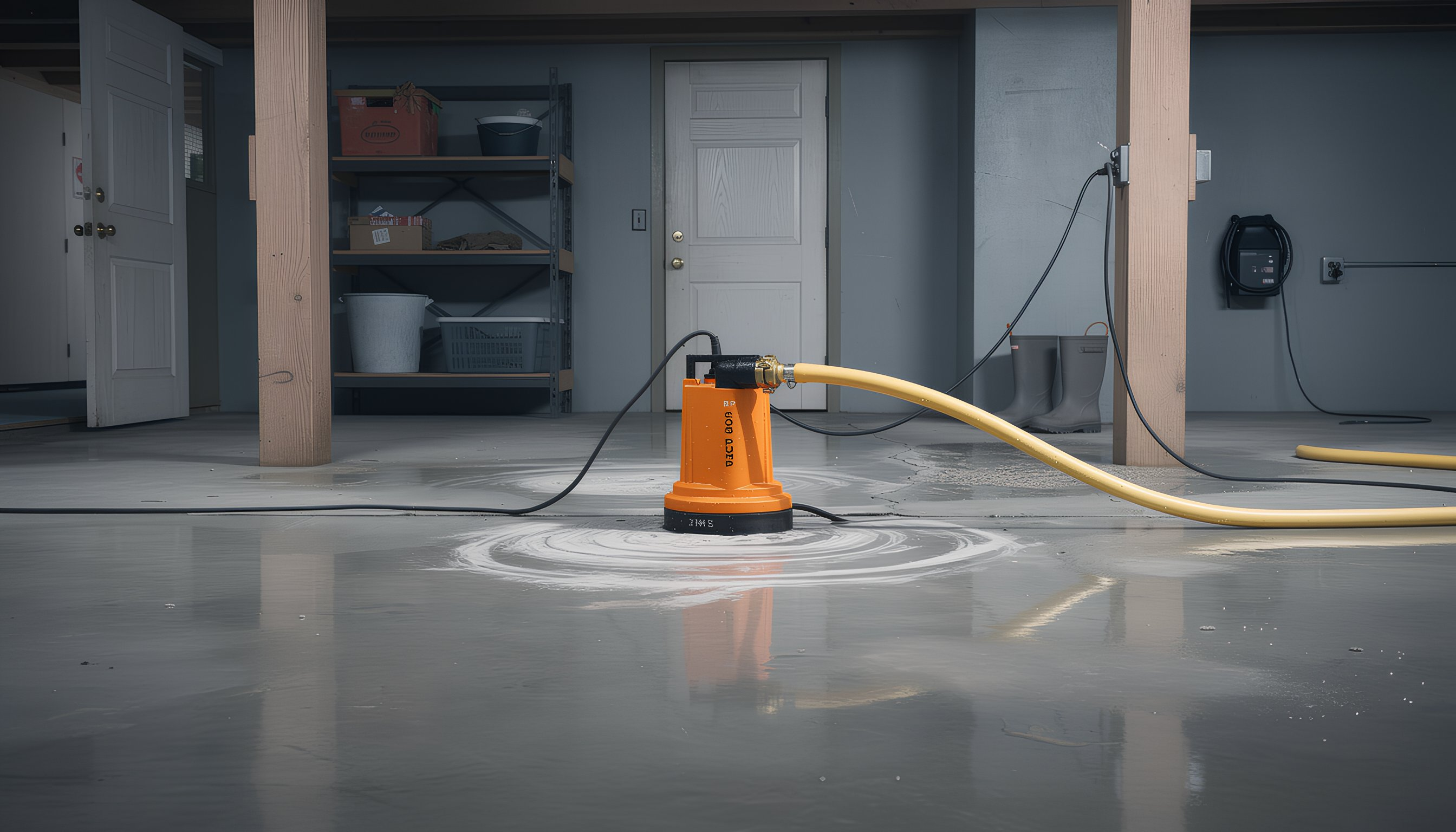
Are you experiencing water problems in a narrow sump or a cramped crawl space where a standard pump simply won't fit? This article will help you discover which basement pump is best suited for locations with limited mobility.
Why a standard basement pump often doesn't fit
When choosing a basement pump for a narrow well, many people encounter the same problem: the float arm. Traditional submersible pumps use a floating float on a cable. This float needs space to rise and fall. In a narrow well, this float can get stuck against the wall, causing the pump to either not turn on (resulting in flooding) or not turn off (causing the motor to burn out).
For small spaces, a compact design with an integrated or vertical float is essential. These pumps move internally or along a fixed guide, allowing the required well diameter to be significantly smaller. You can read more about this in our article " Submersible pump with float vs. without float: What's the best choice? "
The solution: Cellar pump with electronic sensor
The most modern solution for extremely tight spaces is a basement pump that operates with an electronic sensor or electrode. Instead of a mechanical float that physically moves, these sensors detect the water level electronically. This not only saves space but also allows water to be pumped away with millimeter precision.

Submersible pump with switch 1mm
If you're dealing with a very shallow well or a flat basement floor, a submersible pump is the best choice. These pumps can extract water until only a mop-dry result of 1 or 2 mm remains. For successful DIY installation, we recommend consulting " Step-by-Step: Installing a Submersible Pump in Your Basement Yourself ."
Important properties for small wells
When purchasing a basement pump for a small space, you should pay attention to the following three things:
- Trigger level: How high does the water level need to be before the pump starts? In narrow wells, you often want the pump to respond at a low water level.
- Pressure connection: Choose a pump with a hose nozzle pointing upwards instead of to the side. This saves valuable centimeters in width.
- Check valve: In a small well, the volume of water in the discharge hose is relatively large compared to the well's contents. Without a check valve, this water flows back after being switched off, causing the pump to restart immediately.

Electrode Level Switch 1mm
Maintenance in tight spaces
Because a cellar pump is often difficult to access in a narrow pit, preventative maintenance is crucial. Dirt and sludge accumulate more quickly around the suction strainer in a confined space. We recommend cleaning the pit at least twice a year. For more practical advice, read our article " Cellar pump maintenance: 5 tips to extend its lifespan ."
If you do encounter problems, such as a pump that keeps humming, take a look at " Common basement pump problems and how to solve them ".
Frequently asked questions about compact basement pumps
What is the minimum width of a pit for a basement pump?
A pump with a float on a cable often requires 40-50 cm of water. Compact pumps with a vertical float or sensor can often be installed in wells as wide as 20-25 cm.
Can I place a flat suction dredger in a pit?
Yes, that's definitely possible. A flat suction pump is ideal if the well isn't deep, as it can pump water down to almost 0 mm, while a standard submersible pump often stops at 2-5 cm of residual water.
What is the advantage of an electronic level switch?
An electronic switch has no moving parts that can get caught on the wall of a narrow pit, which greatly increases reliability in small spaces.
Share:
Cost of a basement pump including installation in 2026
Installing and Maintaining Your Basement Pump: A Practical Guide